Grand Rapids, Michigan
Bats in the Attic in Grand Rapids
Bats in the attic of a Grand Rapids home can go unnoticed for years, because they come and go in the dark through a gap you would not look at twice.
A fifteen-minute watch at sunset usually settles whether you have them. What you do next depends on the month.
The dusk watch
Stand where you can see the roofline against the sky, starting a little before sunset.
The CDC recommends watching where bats exit at dusk, since it may show how they are getting inside.1
Most bats emerge at dusk to feed.4
Do it on two evenings from different sides of the house, and write down the spot and a rough count.
Daytime evidence
A U.S. Forest Service survey guide lists the marks bats leave on a building: guano, insect parts, and dark stains with white edges where oil and urine have soaked in near the entry.2
You may also hear them; the guide tells surveyors to listen.2
For what the pellets look like and how to treat them, see bat droppings.
Call about bats (616) 741-2909
The pup season sets the schedule
Until the pups fly, closing the exit traps them.
The Forest Service guide adds that disturbance alone can make bats abandon pups or leave for a worse roost.2
So in June the right move is usually an inspection and a date, and the work itself waits.
If bats turn up in the house in the dead of winter, leave them be until spring; the Fish and Wildlife Service warns that a surprise eviction can kill hibernating bats.6
While you wait
Keep the bats and the people apart. Michigan's health department advises keeping bats out of living quarters and occupied spaces.7
In practice that means closing the gaps between the attic and the rooms below: the hatch, pipe chases, the tops of interior walls.
The exterior exit stays open until the exclusion.
Call about bats (616) 741-2909
Next step
Take your dusk-watch notes to the Grand Rapids line by phone or form.
If an independent operator works at your address, the operator inspects, schedules the exclusion for a time the calendar allows, and quotes the job.
Two situations, two first calls
-
A bat is loose indoors
Your first call is to the Kent County Health Department, 616-632-7228, which does a rabies risk assessment and decides whether the bat should be tested.810
The bat indoors page has the hours and steps.
-
Bats are living in the building
Nobody is at risk right now, but the colony will not move itself. That is the call this line exists for.
Go straight to how exclusion works.
Call about bats (616) 741-2909
Grand Rapids by the numbers
- 1953Median year a Grand Rapids home was built9
- 59.5%Share of the city's 84,894 housing units built before 19609
- 16Animals that tested positive for rabies in Kent County across five years, counted in the county's May 2026 bulletin10
More than a third of the city's homes, 37.5 percent, were built in 1939 or earlier.9
Age matters because bats need very little room: some species get through a crevice a quarter of an inch wide.2
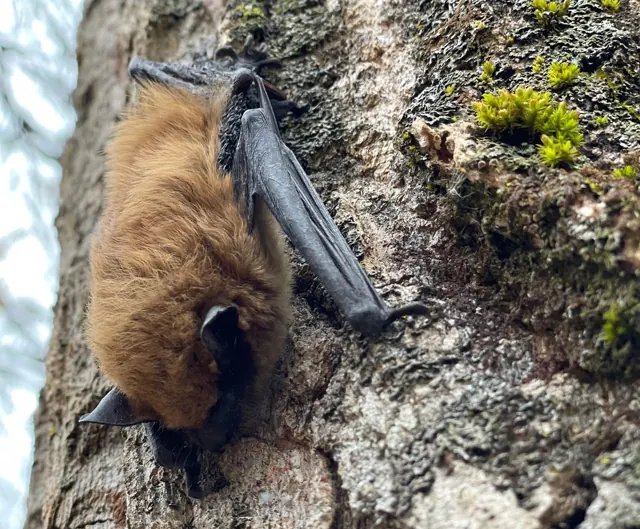
Big brown bat. Photo: Leah Riley/USFWS, public domain.
Why bats choose a house
In summer, female bats gather to give birth and raise young, and buildings suit them.
The U.S. Fish and Wildlife Service says little brown bat maternity colonies are commonly found in warm sites in buildings, such as attics.3
In winter, bats either hibernate or migrate.11
The CDC notes that most leave in fall or winter, which makes those the best seasons to bat-proof a home.1
Common questions
How do I get rid of bats in the attic?
By exclusion, in the right season: the bats leave through a one-way device and the openings are sealed behind them.
Federal guidance says not to exclude a maternity colony between April and August, and not to evict bats found hibernating in winter.
When can young bats fly?
Little brown bat pups are born in May or June and can fly in about four weeks.
Northern long-eared bat young start flying 18 to 21 days after birth.
Sources
Sources
- CDC. Preventing Rabies from Bats.
- USDA Forest Service (Region 6) / BLM bat work group. Bats and Buildings Enclosure 1 (survey protocol and direction for bats in buildings).
- USFWS. Little Brown Bat (Myotis lucifugus).
- USFWS. Northern long-eared bat (Myotis septentrionalis).
- NPS (Office of Public Health). Responding to Bats in Buildings (PDF, version 23.2024).
- USFWS (Midwest Region Office of Communications). Five methods to safely remove a bat from your home.
- MDHHS. Rabies.
- Kent County Health Department. Bat in the Home.
- U.S. Census Bureau. American Community Survey 2020-2024 5-year estimates, year structure built: Grand Rapids, MI.
- Kent County Health Department. Rabid bat bulletin (May 28, 2026).
- USGS. Where do bats live?.
Michigan DNR pages, linked for further reading: Bats.
Bats in the attic, or one loose indoors?
Call the line (616) 741-2909